
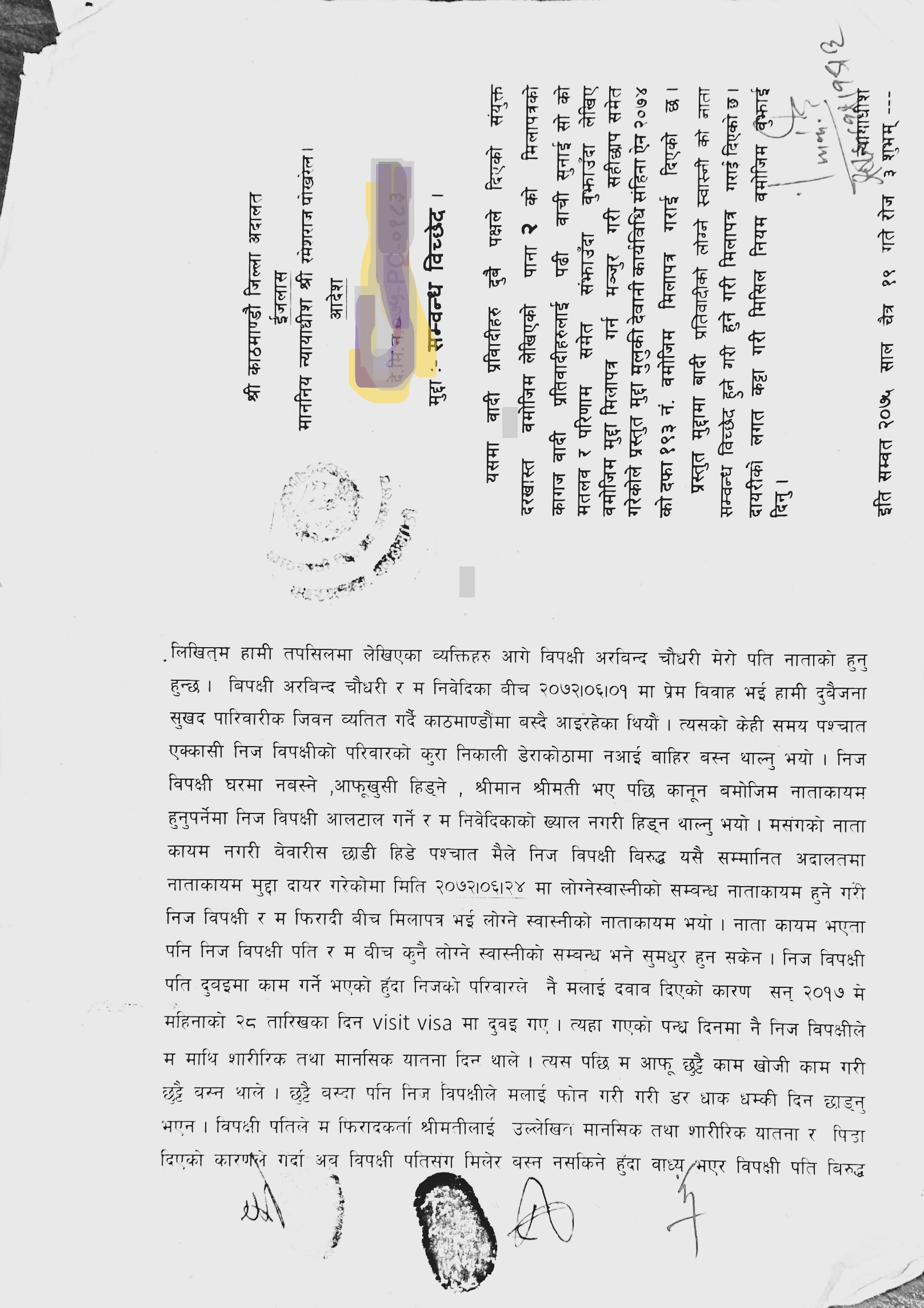
Facts and Grounds for Divorce
That after marriage, serious disputes and irreconcilable differences arose between the parties due to the following reasons:
- Continuous misunderstanding and lack of mutual trust.
- Mental and emotional incompatibility.
- Failure to fulfill marital responsibilities.
- Frequent disputes and separation since [Date of Separation].
The petitioner states that the marital relationship has irretrievably broken down, and there is no possibility of reconciliation. Despite attempts by family members and mediators to resolve the disputes, the parties have been unable to continue their marital relationship peacefully.
The petitioner further submits that the parties have been living separately for more than [period of separation if applicable], and there is no cohabitation or conjugal relationship between them.
Final Divorce Decree in Nepal – Complete Guide
A Final Divorce Decree is the official court-issued document that legally dissolves a marriage in Nepal. It is issued by the District Court after a divorce petition has been processed and approved, either through mutual consent, contested proceedings, or via a Power of Attorney (POA). This decree is essential for legal recognition of the end of a marriage and serves as proof for all civil, financial, and legal purposes, including remarriage, passport issuance, property division, and more.
This article explains what is mentioned in a final divorce decree in Nepal, the process of obtaining it, and the key elements included. It also provides SEO-focused insights for anyone searching for legal guidance or sample formats.
Parties Involved
The first section of a final divorce decree lists the parties involved:
Petitioner: The spouse who has filed the divorce petition. The decree will include their full name, permanent address, and citizenship number.
Respondent: The other spouse against whom the divorce is sought. Their full details, including name, address, and citizenship number, are mentioned.
Including these details ensures that the court order applies only to the legally recognized individuals of the marriage.
Case Background
The decree includes a detailed background of the case, explaining:
- Date and place of marriage.
- Registration details of the marriage (Ward Office or District Administration Office).
- Period of cohabitation and separation.
- Efforts made to reconcile differences (if applicable).
This section demonstrates that the court has reviewed the marriage history and the circumstances leading to divorce.
Proceedings Before the Court
The decree outlines the court proceedings, including:
- Filing of the petition by the petitioner.
- Notice issued to the respondent.
- Appearance of parties or representatives.
- Mediation sessions conducted, if any.
- Submission of supporting documents such as citizenship certificates, marriage registration, and Power of Attorney documents.
This section assures that the court has followed due legal process before issuing the final decree.
Findings of the Court
This is one of the most critical sections. The court presents its findings and observations, such as:
- Confirmation of the validity of the marriage.
- Verification that the parties have irreconcilable differences or continuous separation.
- Assessment of whether reconciliation attempts have failed.
- Determination of whether legal grounds for divorce exist under the Muluki Civil Code, 2074.
- These findings justify the court’s decision to grant divorce and protect the decree from future legal challenges.
Divorce Decree / Court Order
- The main part of the decree is the official court order, which states:
- The marriage is legally dissolved as of the date of the judgment.
- The decree is effective immediately or from a specified date.
- Both parties are legally free to remarry or exercise civil rights independently.
- For mutual consent divorce, the decree may mention that both parties have agreed to the divorce. In contested cases, it confirms that the decision is based on court findings.
Child Custody and Support (If Applicable)
- If the couple has minor children, the decree specifies:
- Custody arrangements – whether the mother, father, or joint custody is granted.
- Visitation rights – schedule for the non-custodial parent.
- Child support / maintenance – monthly or yearly support amounts, considering income and standard of living.
- Courts in Nepal prioritize the best interests of the child while determining custody and financial responsibilities.
Property Division and Financial Matters
The final decree also addresses division of joint property acquired during the marriage:
- Immovable property like houses, land, or apartments.
- Movable property including bank accounts, vehicles, and investments.
- Division is carried out according to Nepalese property laws or mutual agreement.
- If there is no property dispute, the decree notes that explicitly.
Alimony / Spousal Maintenance (If Applicable)
- The decree may include provisions for alimony or maintenance:
- Monthly or annual payment to the financially weaker spouse.
- Duration of support until remarriage, financial independence, or as per law.
- Conditions under which alimony can be reviewed or terminated.
- Alimony ensures that both parties are treated fairly after the dissolution of marriage.
Appeal Rights
The decree states the right to appeal:
Either party may appeal to the High Court within the time limit prescribed by law.
Provides legal recourse in case a party believes the decision was unfair or procedural errors occurred.
This section confirms the legal enforceability of the decree.
Declaration and Signature
The decree ends with:
Declaration by the court confirming the authenticity of the document.
Signature of the presiding judge.
Official court seal for certification.
This final section ensures that the divorce decree is legally binding and recognized for all administrative purposes, including remarriage, passport updates, or property transfer.
Attached Documents
The decree usually lists attachments used for verification, such as:
- Marriage registration certificate.
- Citizenship copies of both parties.
- Child birth certificates (if applicable).
- Proof of separation or mediation attempts.
- Power of Attorney documents (if applicable).
- Property documents.
- These attachments support the legal validity of the decree and help in administrative processes.
Conclusion
A Final Divorce Decree in Nepal is more than just a piece of paper. It is a comprehensive legal document that:
- Confirms dissolution of marriage.
- Details custody, maintenance, and property matters.
- Provides legal protections and rights to both parties.
- Serves as proof for civil, financial, and administrative purposes.
Should you have any questions, please do not hesitate to contact us at +977-9847691209

Ms. Advocate Alpana Bhandari is the CEO of Divorce Lawyer Nepal. She focuses her practice on all elements of family law, including divorce, custody, and property division. She advises prospective clients on, among other things, foreign direct investment (FDI), planned investments, joint ventures, and corporate and individual legal counsel on business establishment, business purchase, sales, contract review, contract drafting, share transfer, and company agreements.